What Happens After the First Executive Protection Concern Is Logged
Executive protection does not begin when a principal steps onto a stage or into a vehicle. It often begins earlier, with a tip, an uneasy interaction, a report that feels “off,” or an outside event that changes the picture. That matters because workplace violence and targeted violence are not abstract concerns. In fact, OSHA says violent acts accounted for 740 fatal workplace injuries in the United States in 2023, while U.S. Secret Service research on attacks targeting federal officials and facilities found that nearly every offender displayed concerning behavior beforehand, with almost two-thirds eliciting concern from others about safety
What matters is not how polished that first report is. What matters is whether the organization has a repeatable way to move from awareness to action. That is the foundation of a modern executive protection program. In Kaseware’s Protecting the Executive guide, executive protection is framed as a business-critical function because today’s exposure spans physical, digital, reputational, and internal risk domains, and legacy, travel-focused models no longer reflect how threats actually emerge or escalate.
At Kaseware, that perspective is grounded in experience. Our company was founded by former FBI Special Agents who built Sentinel, the FBI’s case management system, and that background shaped our view that executive protection investigations work best when they run on clear workflows, shared context, and defensible records.
This article is about that workflow. Not formal scoring models. Not tactical tradecraft. The practical question is simpler: once the first executive protection concern is logged, what should happen next? Federal guidance points to the same basics across workplace violence and threat-management contexts: employees should promptly report actual or potential acts of violence, managers should take reports seriously, investigate in a timely way, and provide feedback on outcomes, and once an employer becomes aware of threats or other indicators of potential violence, it is on notice of the risk.
Where the First Executive Protection Concern Comes From
Executive protection concerns can surface from almost anywhere. An employee reports a disturbing comment. An executive assistant notices an unusual pattern of contact. A visitor interaction raises alarms. A current or former employee begins behaving in a way that changes the picture. A personal issue starts spilling into the workplace. Cal/OSHA’s framework is a useful reminder of how broad the intake picture can be: concerns may originate from outsiders with no legitimate business at the worksite, customers or visitors, current or former employees, or people with a personal relationship to an employee.
That matters because the first signal is often incomplete. It may sound vague. It may not come with evidence attached. It may not seem serious enough, standing alone, to justify a full executive security response. But early reporting still matters. The Department of Labor says employees should promptly report actual or potential acts of violence, and Secret Service research on targeted violence shows that concerning behavior is often visible to others before violence occurs and often causes fear for the safety of self or others.
What Happens After a Concern Is Raised
In our guide, we frame what happens next as a continuous operational cycle. Executive protection concerns are rarely linear. A case can move from intake to assessment, then loop back when new information appears. A response can uncover facts that change the plan. The point is not to force every incident into a rigid template. The point is to make sure nothing gets dropped between teams, handoffs, or time-sensitive decisions. Kaseware’s guide emphasizes repeatable operations, intelligence integration, and cross-functional coordination for exactly that reason.
The cycle looks like this:
- Threat Intake: Capture tips, alerts, or concerns early.
- Assessment: Evaluate credibility, severity, and escalation needs.
- Protection Plan: Assign roles and coordinate protective actions.
- Incident Response: Execute plans and adapt in real time.
- Documentation: Record what happened and who responded.
- After-Action Review: Identify gaps, lessons, and improvements.
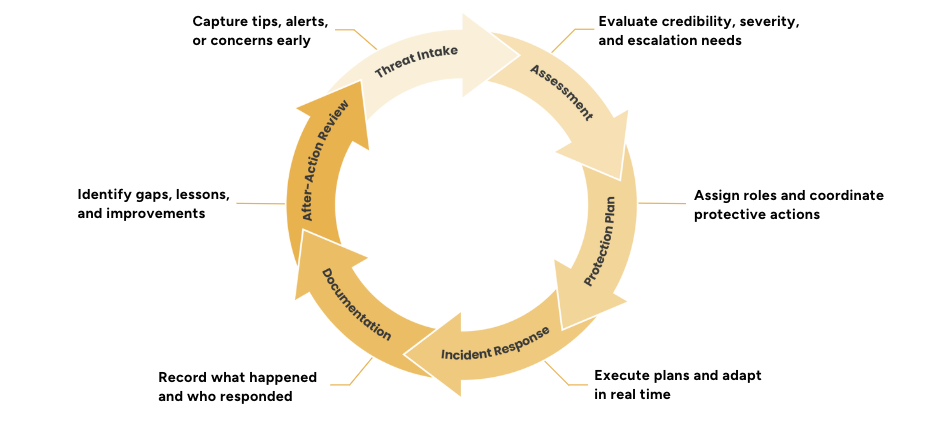
That sequence gives executive protection teams, investigations teams, HR, legal, and leadership a common operating picture. It also reflects how executive security incidents actually unfold: one concern becomes a case, the case becomes coordinated action, and the outcome becomes part of the organization’s working memory.
Determining Credibility and Urgency
The assessment phase is where teams slow the moment down just enough to understand what they are actually dealing with. What was reported? By whom? When did it happen? How specific was the behavior or communication? Is there a direct connection to an executive, a workplace, a residence, an event, or a travel plan? What evidence exists right now that needs to be preserved, such as screenshots, call logs, access data, or witness accounts?
The Department of Labor’s guidance says managers should take reported incidents seriously and investigate threats and disruptive behavior in a timely fashion, while CISA recommends proactive programs that detect, identify, assess, and manage risk before concerning behavior escalates.
Credibility is rarely a yes-or-no question based on one fact. More often, it is a matter of context. A single comment may not mean much by itself. A pattern of repeated contact, fixation, escalation, grievance, proximity, or changing behavior may mean much more. That is why targeted violence research is relevant. The Secret Service found that most attackers in its mass attack study had already displayed behavior that elicited concern in others. For executive protection investigations, that is a reminder to treat early concerns as signals to clarify, not noise to dismiss, because they are not yet definitive.
Urgency is what changes the operating tempo. Some executive protection concerns call for monitoring, follow-up, and coordinated internal review. Others require immediate escalation. If the available facts suggest an active threat or imminent danger, the organization should not be debating ownership. Security functions are expected to help defuse situations, assist with or conduct investigations, and serve as liaisons with outside law enforcement when appropriate.
Who Needs to Be Involved and When
In most organizations, corporate security or the executive protection function should own the case record and the coordination of next steps. That does not mean they should work alone. Kaseware’s executive protection guide explicitly highlights cross-functional coordination with legal, HR, IT, and communications as part of a modern program, because executive risk rarely stays confined to one lane. A threat can have employment implications, privacy issues, digital exposure, reputational implications, and business continuity consequences all at once.
The Department of Labor’s workplace violence program shows what that multidisciplinary model looks like in practice. It assigns responsibilities across managers, security, safety, and health managers, employee assistance, legal counsel, public affairs, and human resources. OSHA guidance similarly says that if a prevention team is used, it should include representatives from senior management, operations, workers, security, occupational safety and health personnel, legal, and HR. That is a useful model for executive protection concerns because it prevents the two most common failures after first notice: delays caused by uncertainty and fragmented decisions made in parallel by different teams.
The key is clarity. Who is informed immediately? Who is consulted before action is taken? Who approves response decisions? Who owns the record? Who is responsible for follow-up? If those answers are unclear after the concern is logged, the organization is already losing time.

Kaseware for Executive Protection
Designed to align with how corporate security teams already work, while introducing the structure required to scale and mature programs effectively.
From Awareness to Action
This is the point in the cycle where assessment becomes a protection plan. Not every concern justifies the same response, and it should not. Some situations call for rapid intervention and external coordination. Some call for internal interviews, monitoring, or additional collection. Some call for executive awareness, event-related adjustments, or tighter coordination around facilities. The larger principle is straightforward: reported threats and disruptive behavior should be investigated promptly, necessary action should follow, and functional experts should be pulled in when appropriate.
What matters most is that the concern produces an actual plan. There should be an owner. There should be assigned roles. There should be a decision about what happens now, what gets watched, what gets escalated, and when the issue is revisited. In the language of the graphic, this is where Protection Plan becomes Incident Response: roles are assigned, actions are coordinated, and the response adapts in real time as facts change.
This is also where modern executive security programs separate themselves from ad hoc security efforts. Our guide stresses repeatable protection models and intelligence-led operations because consistent response is what improves handoffs, builds leadership confidence, and reduces the chance that one concerning contact turns into three disconnected records across different teams.
Just as important, strong teams close the loop. The reporting party may not receive every operational detail, but the report should not disappear into silence. The Department of Labor explicitly says managers should provide feedback to employees regarding the outcome of their reports. That kind of follow-through strengthens reporting culture and increases the odds that the next concern is raised early instead of late.
Why Documentation and After-Action Review Matter
Documentation is where executive protection programs stop relying on memory. Once a concern has been reviewed or acted on, the record should make the situation legible to the next person who touches it. What was reported? When? By whom? What evidence was preserved? Who reviewed it? What decisions were made? Who responded? What remains open? The documentation stage in the graphic is simple on purpose: record what happened and who responded. In practice, that is what turns a scattered concern into usable institutional history.
Strong documentation is also a governance issue. OSHA says many employers with more than 10 employees must keep records of recordable work-related injuries and illnesses, and all employers must notify OSHA within 8 hours of a work-related fatality and within 24 hours of a work-related inpatient hospitalization, amputation, or loss of an eye. California’s workplace violence rules also require covered employers to maintain a violent incident log with details such as the date, time, location, type of violence, and consequences of the incident. Depending on the incident and jurisdiction, executive security incidents can carry formal recordkeeping and reporting obligations in addition to internal case documentation requirements.
Documentation also makes learning possible. CISA recommends proactive, prevention-focused programs that detect, identify, assess, and manage risk before concerning behavior escalates, and the Department of Labor assigns safety and health managers responsibility for preparing trend reports and other analyses of incident data. That is the logic behind the After-Action Review stage in the graphic. Once the immediate issue is stable, the organization should ask hard questions: Where were the handoff gaps? Did the right stakeholders get involved at the right time? Was the record complete? Did the response match the facts? What should change before the next case arrives?
What a Mature Response Looks Like
A mature executive protection program does not treat the first concern as a nuisance to clear from the inbox. It treats it as the moment the organization either establishes control or loses it. The process is not glamorous. It is operational discipline: capture the concern, assess it, involve the right people, assign ownership, act proportionately, document the outcome, and learn from the case. That is how executive protection becomes more than a reactive service. It becomes a repeatable business function that protects leaders while supporting continuity, decision-making, and trust.
At Kaseware, we built our platform to support that kind of response by centralizing investigative details, streamlining case management, and giving teams incident management, document management, evidence management, task coordination, dashboards, and analytical tools in one place. For example, if a concerning tip comes in ahead of an executive event, teams can open an incident, attach screenshots and reports to a digital case file, notify stakeholders through email, text, mobile app, or desktop alerts, and assign follow-up tasks across security, HR, and legal. If a case starts to involve repeated contacts, linked individuals, or multiple locations, link analysis and geospatial visualizations can help teams spot patterns faster. And if personnel are in the field during an executive security incident, mobile access helps keep current case details, evidence, and response information within reach.
For a deeper look at the workflow behind this corporate executive safety model, download Kaseware’s Protecting the Executive: A Strategic Guide to Designing a Modern Executive Protection Program today. The guide covers program maturity, repeatable protection models, intelligence integration, cross-functional alignment, and metrics that help security leaders demonstrate value to the business.