Workplace Violence Hub

The threat of workplace violence is one that customers, employees, and organizational leaders know all too well. While you hope it will never happen to your company, the fact remains that over 2 million people per year in the US are affected by violence in the workplace. To combat this threat, organizations need to have the right tools, technologies, and policies in place.
This guide provides an overview of how workplace violence can impact your organization. You’ll learn about the latest regulations designed to prevent threats at work. You’ll also find helpful information on building an effective workplace violence prevention program, from policies and training to technology integration.
The Changing Regulatory Landscape
Local and federal regulatory bodies recognize the damaging effect of workplace violence. OSHA has long been a leader in developing workplace safety requirements. While the federal agency does not have specific requirements for violence prevention, its general duty clause mandates that employers provide a safe workplace. OSHA recommends that all employers implement prevention programs, provide safety training for all employees, and create incident response and documentation protocols.
In 2023, Texas enacted Texas Senate Bill 240. Now a part of the Texas Health and Safety Code, the law applies to healthcare facilities, which are known to be at a high risk of workplace violence. To remain compliant, healthcare facilities must have a written workplace violence prevention plan in place. By June 2024, 47 other states had laws in place to address workplace violence in healthcare settings.
On July 1st, 2024, California became the first US state to implement broad legal requirements for workplace violence prevention: California Senate Bill 553 (SB 553). The legislation, which applies to most CA businesses, says that employers must “establish, implement, and maintain an effective written workplace violence prevention plan.” A compliant Workplace Violence Prevention Plan (WVPP) must include:
- Involving employees, their representatives, and leadership in plan development.
- Receiving reports of workplace violence and protecting victims from retaliation.
- Providing workplace violence prevention training for all employees.
- Responding to emergencies and potential threats.
- Performing investigations of past incidents and keeping accurate records.
- Identifying and fixing any potential workplace hazards in a reasonable timeframe.
- Reporting all injuries, illnesses, and deaths at or related to the workplace.
Other states are following suit with expanded laws for different industries and employer types. For example, HB1919 mandates that Virginia employers with more than 100 employees implement and maintain workplace violence policies by January 1, 2027. A recently passed law in New York will require retail employers to implement violence protection programs and provide training to employees. Washington has added requirements for late night retail establishments like convenience stores to help prevent crime.
Workplace Violence Costs
Workplace violence costs employers approximately $167 billion per year in the United States. Multiple factors play into these costs:
Financial
Penalties for noncompliance and legal fees for employee lawsuits.
Reputation
Reduced trust, lower profits, and high PR crisis management fees.
Operational
Damage to equipment, project interruptions, and decreased productivity
Team/Personnel
Low team morale and higher turnover.
The Challenge:
Protect employees and customers from a variety of internal and external threats in a rapidly changing environment.
The Solution:
Develop transparent violence prevention protocols, use technology to make reporting and responding easier, and provide regular training to employees.
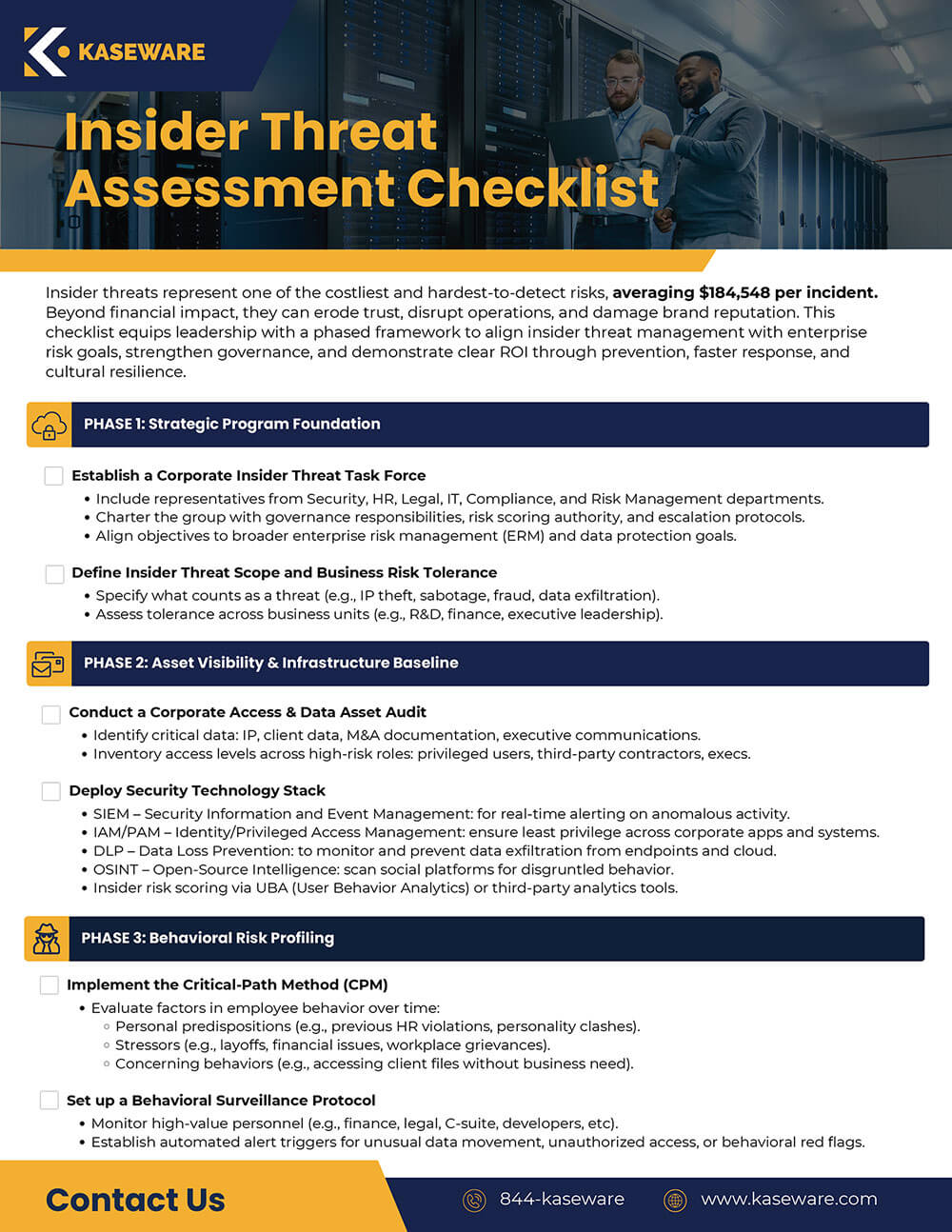
Insider Threat Checklist
The tools to strengthen governance, align with enterprise risk goals, and prove ROI through measurable outcomes.
Technology’s Role in Preventing Workplace Violence
Despite the rise in workplace violence, many employers lack an effective violence prevention program. Even those with policies in place often fail to safeguard confidential information, react to incidents quickly, and keep proper documentation for investigations and post-incident management.
Key Trends:
annual victims of workplace violence
workplace violence incidents go unreported
of companies have no workplace violence prevention plan
of workers impacted by violence leave within 1 year
Managing Different Threat Types
Workplace violence prevention should address all types of violence and who they target. Remember, violence isn’t always physical. A significant portion of workplace violence is made up of threatening behavior, verbal abuse, and harassment, which can take place in person or digitally. OSHA classifies workplace violence into four types based on the people they involve.
Criminal Intent violence is perpetuated by a person with no connection to the workplace or its employees, often in the form of burglary. They typically occur in locations with cash or valuables on-site.
Customer/Client violence occurs when a customer becomes violent towards a worker, usually in response to a stressful situation. Unfortunately, a common example of this is patient violence towards healthcare workers like nurses.
Worker-on-Worker violence can include physical injury, verbal abuse, and other forms of aggression between employees. While shootings are the most highlighted by the media, nonfatal workplace injuries and sexual assault also occur all too often.
Personal Relationship violence takes place between an employee and someone personally connected to them, like a spouse, partner, or family member. Personal verbal and physical violence are usually unrelated to work but may occur in the workplace.
Identifying the Pathway to Violence: Tools and Strategies for Workplace Safety
This guide provides a framework for developing an effective workplace violence prevention program, covering risk assessment, training, reporting mechanisms, and compliance with evolving legal requirements.
Underreporting and Its Consequences
One in four incidents of workplace violence go unreported. Underreporting has lasting impacts on your organization. It allows the cycle of violence to continue, prevents leadership from taking action, and can pave the way to escalation.
Why don’t employees report violence?
First and foremost, many workers are afraid of retaliation. Many workplaces have failed to protect the identity of informants and victims, placing them in immediate danger. Employees who see this are far less likely to report future incidents. If the violence is coming from higher up, employees may also worry that submitting a report will lead to demotion or termination.
Even if an employee wants to report a threat or violent act, their workplace may not have a reporting structure or policy in place. A manager or HR representative is usually the go-to in these situations, but may not have the right tools to escalate the information or properly investigate it.
Without timely reporting, employers can’t identify trends in troubling behavior or take proactive steps to prevent violence. They may label an incident as the first offense, not knowing it was a third or fourth issue, and take insufficient action. Furthermore, if incidents are not properly tracked and documented, employers can face regulatory noncompliance penalties and investigations.
Technology as a Violence Prevention Tool
A violence prevention plan isn’t enough; you need to be able to recognize trends, protect confidentiality, and take action quickly to protect your employees and customers. Kaseware’s investigation management software is designed to help:
Centralized reporting allows your team responsible for handling incidents to move from intake to resolution faster.
Public portal access helps you collect tips, reports, and evidence submissions from internal employees or external sources, securely and on your terms.
Sensitive data protection for the identity of informants and victims, including the option for anonymous tips, plus defined user access controls to manage information visibility.
Link related incidents over time to highlight trends in troubling behavior and adjust your response appropriately.
Support for collaboration between departments and with law enforcement for real-time communication and faster incident resolution.
Maintain compliance with regulatory requirements for proper documentation, incident reporting, and post-incident investigation.
Workplace Violence Prevention ROI
Most importantly, an effective workplace violence prevention plan makes your workers and customers safer. In many cases, effective incident reporting and response can prevent repeat offenses and escalation. When a violent act can’t be prevented, transparent protocols allow your team to respond quickly and efficiently.
Beyond safety, workplace violence prevention offers tangible financial benefits. Organizations with violence prevention plans have higher employee loyalty and lower turnover. They spend less on legal fees and workers’ compensation claims. They minimize disruptions that affect productivity and profitability. In addition, organizations with compliant plans and protocols can avoid costly penalties from regulatory bodies.
“Employers implementing proactive workplace violence prevention programs are likely to find sound economic benefits that go far beyond improved safety and security and reduced risk of lawsuits and settlements.”
Designing an Effective Violence Prevention Program
A successful violence prevention program includes several key components.
Risk Assessment
Regular evaluations of workplace climate, potential security gaps, and historical incident data.
Tools & Technology
Accessible reporting portals, centralized case management, and compliant documentation.
Policy Transparency
Detailed information on types of violence, how to report incidents, and what actions and consequences to expect.
Threat Assessment Team
Specific team members trained to respond to threats and collaborate with law enforcement when needed.
Ongoing Training
Training on organizational policies as well as emergency response steps to reduce injuries and fatalities.
Follow Up & Review
Formal post-incident investigations and plan updates to improve safety and response protocols.
Creating a Culture of Safety
Best Practices:
- Involve leadership from multiple departments in plan development and implementation.
- Provide ongoing training so workers know how to report and respond to incidents.
- Respond to incidents quickly and use disciplinary measures to prevent repeat offenses.
- Update policies as regulations evolve to maintain compliance and avoid penalties.
Resources & Tools for Workplace Violence Protection
GET A PERSONALIZED DEMO
Discover how you can use Kaseware to support your workplace violence prevention program.
"*" indicates required fields