Critical Infrastructure Hub

The new reality for critical infrastructure is that it is no longer simply connected with national security, It is a frontline component that is growing increasingly complex due to the convergence of threats across cyber, physical, and geopolitical fronts.
Governmental agencies now share critical infrastructure protection responsibilities with private sector operators. This creates additional stressors for businesses that need to protect their own systems and interests but also consider the well-being of critical infrastructure. At times, transparency and other safeguards may be at odds with business budgets, speed-to-market goals, data privacy, and intellection property protections.
Why Critical Infrastructure Is Now a National Security Priority
Infrastructure is the foundation of economic stability, public safety, and national resilience. Economically, it provides the power, transportation, and communications that businesses depend on to keep supply chains moving and operations running without interruption. Public safety relies on it just as heavily. Critical infrastructure powers essential utilities, enables emergency response, and supports the surveillance, security, and healthcare services communities count on, particularly in times of crisis.
National resilience is an especially complex dimension of infrastructure because these systems are deeply interconnected. A failure in one area can have a ripple effect across sectors, making coordinated redundancy not just best practice, but a strategic necessity. When government and private entities both invest in critical infrastructure security, they build the collective capacity to respond to and recover from attacks.
Threats are expanding, and the bad actors include insiders, activists, criminals, and nation-state entities. Many of these target private entities, leaving them with the increasing burden of being the first-line defense.
Key Data
of attacks impacted critical infrastructure organizations.
IBM X-Force Threat Intelligence Index 2025of security chiefs say geopolitical risk threatens the security of supply chains.
2025 World Security Report by G4S Allied Universalof global leaders expect corporate strategies addressing supply chain disruption to have the most potential for driving risk reduction over the next decade.
World Economic Forum Global Risks Perception Survey, 2025-2026of business and tech leaders are prioritizing cyber risk investment in response to geopolitical volatility.
PwC’s 2026 Global Digital Trust InsightsThe Business Reality: Operating Under Constraints
Enterprise security professionals already face budget pressures and resource limitations. With the added element of infrastructure defense, they must also consider how to balance competing priorities and how to respond to executive demands for proof of ROI and measurable outcomes.
It’s challenging to justify security investments in business terms because the spending results in savings versus revenue. It can save companies from monetary damage, lost business, loss of reputation, increased insurance costs, and more. Additionally, damage to critical infrastructure that impacts entire industries and economies can be hard to predict and measure.
Quantifying risk transforms abstract threats into financial decisions. Assigning dollar values to downtime, legacy system maintenance, and redundant tooling creates shared language between security teams and business leadership. This ties infrastructure investment directly to operational continuity. When security priorities can be expressed in the same terms as other capital decisions, it’s easier to define shared goals and responsibilities around critical infrastructure.
The National Infrastructure Protection Plan (NIPP) Framework
The National Infrastructure Protection Plan (NIPP) promotes critical infrastructure risk management through a collaborative effort among U.S. public and private entities. The goal is to minimize, identify, and disrupt threats to physical and cyber assets, while also maximizing resilience, response, and recovery efforts in the event of attack or disaster.
While federal, state, local, and private sector stakeholders share broad interests and goals, translating those into clearly distributed responsibilities is often where alignment breaks down in practice. Real-world enterprise risk strategies often prioritize cost, speed, and operational continuity in ways that map cleanly with the NIPP’s risk management framework.
Investigative case management software can bridge the gap by creating documented, trackable workflows around incidents and risk decisions. Organizations can assign ownership, maintain audit trails, and surface patterns that inform both internal strategy and cross-sector coordination.
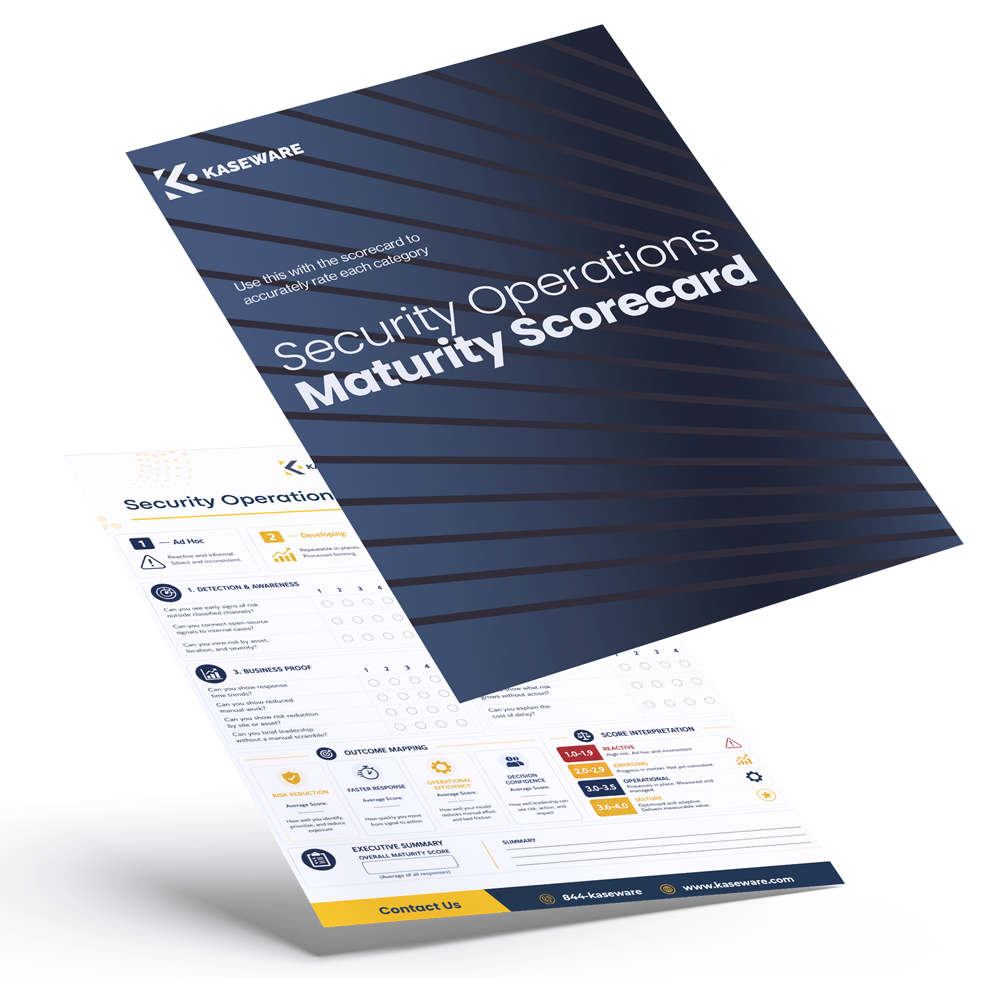
Security Operations Maturity Scorecard
How mature is your security operation? Use this self assessment scorecard to measure your organization’s security capabilities across key operational areas, pinpoint areas for improvement, and build a roadmap toward a more proactive and resilient security program.
The Evolving Threat Landscape
As the physical world increasingly interacts with the digital realm through smart devices, connected networks, and expansive communication systems, that cyber-physical convergence has resulted in smart infrastructure but also overlapping vulnerabilities.
Real-time monitoring and analysis of cyber and physical data is critical for always-on systems. It creates the situational awareness needed to predict emerging threats, detect active incidents, and respond effectively.
Geopolitical tensions are spurring malicious actors to target operational technology (OT) and supervisory control and data acquisition (SCADA) systems to disrupt the supply chain. This modern threat landscape is increasingly complex and difficult to defend against. Insider threats and decentralized attack models have expanded the perimeter beyond traditional boundaries.

The Defining Challenge: Speed to Threat
One of the greatest challenges is the increasing speed at which threats appear and impact infrastructure. Traditional intelligence and response models are no longer adequate to address the new nature of threats. Both public and private organizations need real-time situational awareness.
Security teams face operational stressors as the speed and sophistication of modern threats outpace conventional security frameworks. Challenges include:
Traditional tools that don’t respond to threats in real time
Compliance burdens created by information sharing across sectors
Insufficient resources to handle real-time prioritization and decision-making
Scattered tools that impede coordination between teams and delay response times
Security teams in continuous response mode rather than distinct incident cycles
Under these conditions, investigative case management breaks down precisely when it matters most.
From Responsibility to ROI: Reframing Security Investment
With more advanced detection, management, and protection tools, users also get more sophisticated capabilities to measure their business impact.
Comprehensive investigation case management software helps security teams:
Reduce risk
Contain impact
Operate more efficiently
Make data-supported decisions with confidence
It also helps executives translate national security outcomes into business-driven metrics, expanding beyond a compliance-driven focus.
Operationalizing Risk in a Modern Threat Environment
Fragmented tools lead to siloed intelligence, preventing security teams from seeing the larger picture around threats. To fill those gaps, they need unified workflows and actionable intelligence. This is solved by integrating systems with a comprehensive investigation case management platform.
This solution enables real-time prioritization and response. Real-time actionable intelligence allows security teams to improve operations and demonstrate measurable outcomes that align with business objectives.
Critical Infrastructure Security in a New Era of Risk
How security leaders can reduce risk, improve resilience, and justify security investments while protecting mission critical assets.
The Role of Intelligence and Open-Source Intelligence
Open-source intelligence (OSINT) allows shared and accessible information beyond classified intelligence sources. This can be critically important in early threat detection across both public and private sector stakeholders, but it also creates the risk of responding to unreliable or manipulated intelligence.
That presents the operational challenges of identifying intent, sentiment, and emerging risks from a flood of unverified information. And, how do you integrate open-source intelligence into decision-making fast enough for meaningful action? That demands clear validation protocols, defined thresholds for acting on unverified intelligence, and organizational structures that treat OSINT as only one input among several.
Bridging National Security and Business Outcomes
Security is not a cost center, so organizations will benefit from positioning those investments as business enablement. Aligning security operations with enterprise risk management requires organizational commitment and the modernization of operational tools and processes.
Private companies should enable their security leaders to make defensible investment decisions by providing them with the tools that quantify outcomes. Then, give them the opportunity to tie those to business performance.
Demonstrating impact through measurable results (like reduced downtime, mitigated risk exposure, and faster incident resolution) creates financial accountability. It also reframes security investments from reactive overhead to strategic assets. For private sector stakeholders, that shift also allows intentional and meaningful participation in national infrastructure resilience.

A New Operating Model for Critical Infrastructure
The threats to critical infrastructure don’t differentiate between government and private sectors, so neither should the security efforts. Companies are now charged with protecting national interests while delivering business value. These are not competing priorities but mutually reinforcing ones.
Time is of critical importance for organizations to modernize security operations and tools to match the pace and complexity of new and emerging threats. With solutions that scale across sectors and prove impact, this new cooperative operating model will be more effective than any sector can deliver on its own.
Executive POV Report
Designed for security and operational leaders, this executive summary highlights the most pressing risks facing critical infrastructure organizations and outlines the strategic approaches top performers are using to improve visibility, preparedness, and response capabilities.
GET A LIVE, CUSTOMIZED DEMO
Uncover the tools that operationalize risk management,
accelerate response, and prove impact.
"*" indicates required fields