Insider Threats • Insider Risk • Integrated Security
Corporate Security Hub

A single, authoritative resource for security leaders seeking to detect, deter, and respond to insider threats, workplace violence, cyber-physical risks, and industry-specific challenges.
Why Corporate Security Matters More Than Ever
Corporate security is no longer a matter of “cyber versus physical.” Today’s threats are converged, with incidents often crossing both domains. A malicious insider can exfiltrate data from a secure facility, while a cyberattack can disable physical access controls or safety systems. Add in the human factor—workplace violence, employee stress, remote work vulnerabilities—and you have a complex, fast-moving risk landscape.
Key Trends:
increase in insider threats over the past two years.
Insider Threat Guideof cyberattacks are carried out by insiders.
Insider Threat Guideannually in lost productivity, legal fees, and medical expenses is the cost U.S. businesses face due to workplace violence.
Workplace Violence GuideIoT devices globally in 2024, each representing a potential attack.
Security Convergence GuideUnderstanding Insider Threats
An insider threat is any security risk that originates from someone with authorized access to your systems, facilities, or data. This could be a current employee, contractor, vendor, or even a former staff member.

Types of Insiders:
- Malicious: Intentionally cause harm.
- Negligent: Cause harm through mistakes or poor judgment.
- Compromised: Have their credentials hijacked by external attackers.
The Challenge:
Insiders operate within normal permissions, making them difficult to detect. The average incident costs $184,548 to contain, with additional reputational and operational damage.
The Solution:
Proactive Detection
- The Critical-Path Method identifies escalating risk factors—personal predispositions, stressors, and concerning behaviors—before a “hostile act” occurs.
- Tools like OSINT, Privileged Access Management (PAM), SIEM, and User Behavior Analytics (UBA) surface suspicious activity early.
Building a Proactive Insider Threat Program
A truly effective insider threat program integrates people, processes, and technology:
1. Form a Cross-Functional Team
Include HR, IT, legal, compliance, and security to share intelligence and act quickly.
2. Use Behavioral + Technical Indicators
Link behavior analytics with privileged access monitoring and external intelligence.
3. Assess and Prioritize Risks
Consider industry, size, culture, and data sensitivity.
4. Create Clear Policies + a Trust-Based Culture
Promote transparent reporting and provide support to employees under stress.
5. Apply Rapid Mitigation Techniques
Control access, activate incident response plans, offer psychological support, and enforce legal measures when necessary.
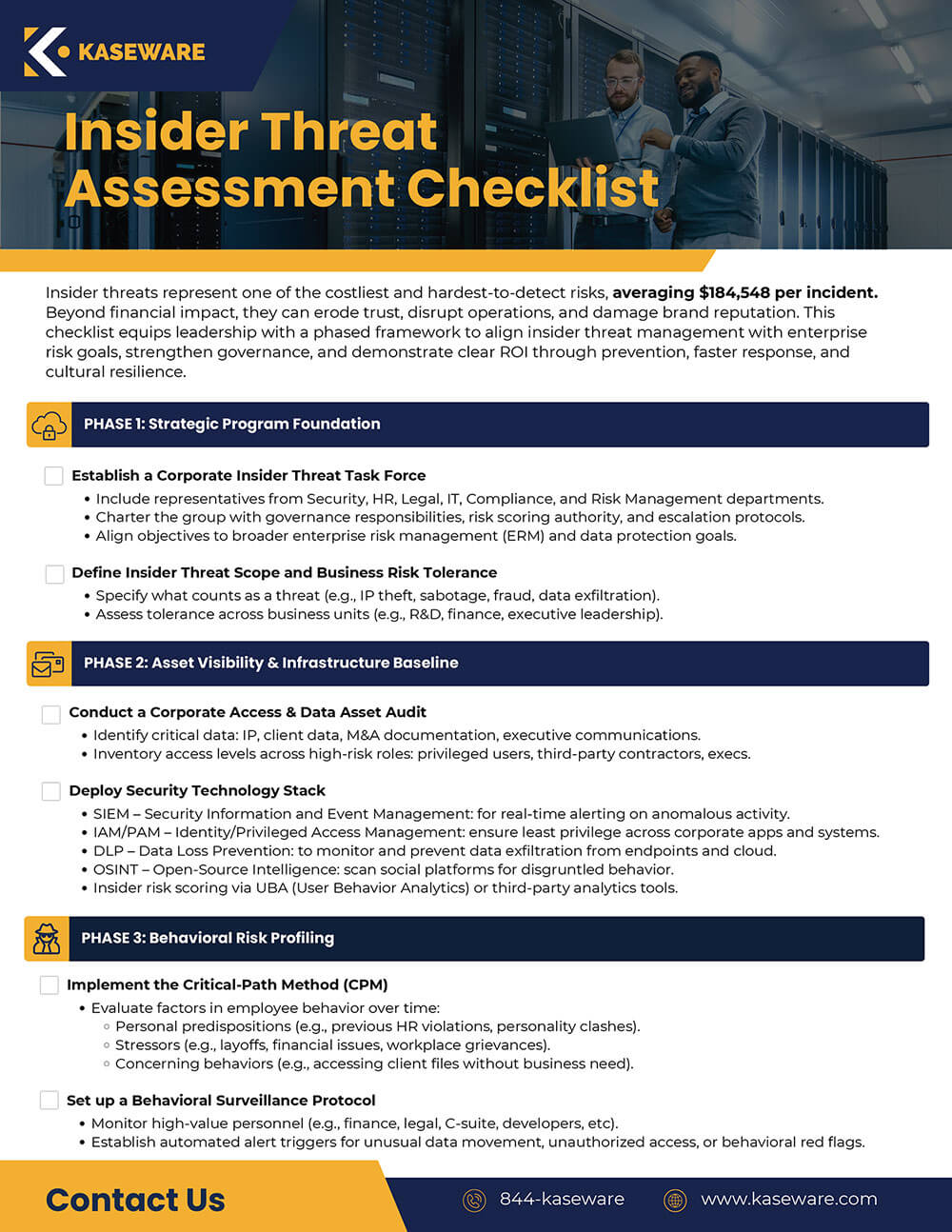
Insider Threat Assessment Checklist
Insider Threats Represent One Of The Costliest And Hardest-To-Detect Risks, Averaging $184,548 Per Incident.
Security Convergence: Breaking Down Silos
Security convergence integrates physical security, cybersecurity, and business continuity into a single, coordinated strategy. With threats often spanning both domains, siloed teams are a liability.
Benefits of Convergence:
- Eliminate duplicated tools and processes, saving costs.
- Detect threats faster by linking physical and cyber access data.
- Improve coordination and communication.
- Increase visibility with executives and boards.
Key Enablers:
- One Security Leader: A CSO overseeing all security risks.
- Converged Security Centers: Unified monitoring of cyber-physical systems.
- IoT & CPS Risk Management: Securing billions of interconnected devices.
Security Convergence Guide
A Unified Approach to Modern Challenges
Workplace Violence Prevention
Workplace violence is both a people safety issue and a business risk.
Four Primary Types:
1. Criminal Intent
Perpetrator has no relationship with the organization.
2. Customer/Client
Violence from service recipients.
3. Worker-on-Worker
Conflicts between employees.
4. Personal Relationship
Domestic violence carried into the workplace.
Regulatory Pressures:
- California SB 553 – Mandated violence prevention plans for high-risk industries.
- Texas SB 240 – Healthcare-specific prevention requirements.
Prevention Toolkit:
- One Security Leader: A CSO overseeing all security risks.
- Converged Security Centers: Unified monitoring of cyber-physical systems.
Sector-Specific Security Strategies

Airlines
Airlines face unique challenges: massive passenger volumes, strict regulatory oversight, and high-profile incident risk. Transitioning from paper logs and siloed systems to integrated platforms enables:
- Real-time incident tracking.
- Faster cross-department collaboration.
- Compliance automation.
Utilities
Utilities must balance physical and cyber protection under NERC CIP 8 (incident response) and CIP 14 (physical infrastructure protection). Modernizing from outdated systems reduces:
- Breach risk.
- Regulatory penalties.
- Incident response delays.
Kaseware enables centralized asset risk tracking and automated compliance reporting.

Guide to Creating a Proactive Insider Threat Strategy
Everything You Need to Deter, Detect, & Mitigate Risk from Insider Threats
Culture, Training, and Leadership
Technology and policy only work if your people are engaged and committed.

Best Practices:
Leadership sets the tone—model compliance and security-minded behavior.
- Offer regular, role-specific training.
- Create open, retaliation-free reporting channels.
- Recognize and reward proactive security behavior.
Technology as the Backbone of Corporate Security
Unified case management platforms are mission-critical for modern corporate security:
Best Practices:
Leadership sets the tone—model compliance and security-minded behavior.
- Centralize incident and investigation data.
- Link analysis between cyber and physical events.
- Automate compliance reporting.
- Enable real-time collaboration.
Commonly Integrated Tools:
- OSINT
- IAM & PAM
- SIEM & UBA
- Data Loss Prevention (DLP)
Resources & Tools
Guides:
Blog Collections:
Interactive Tools:
GET A LIVE, CUSTOMIZED DEMO
Your organization’s people, data, and reputation deserve
more than reactive security.
"*" indicates required fields